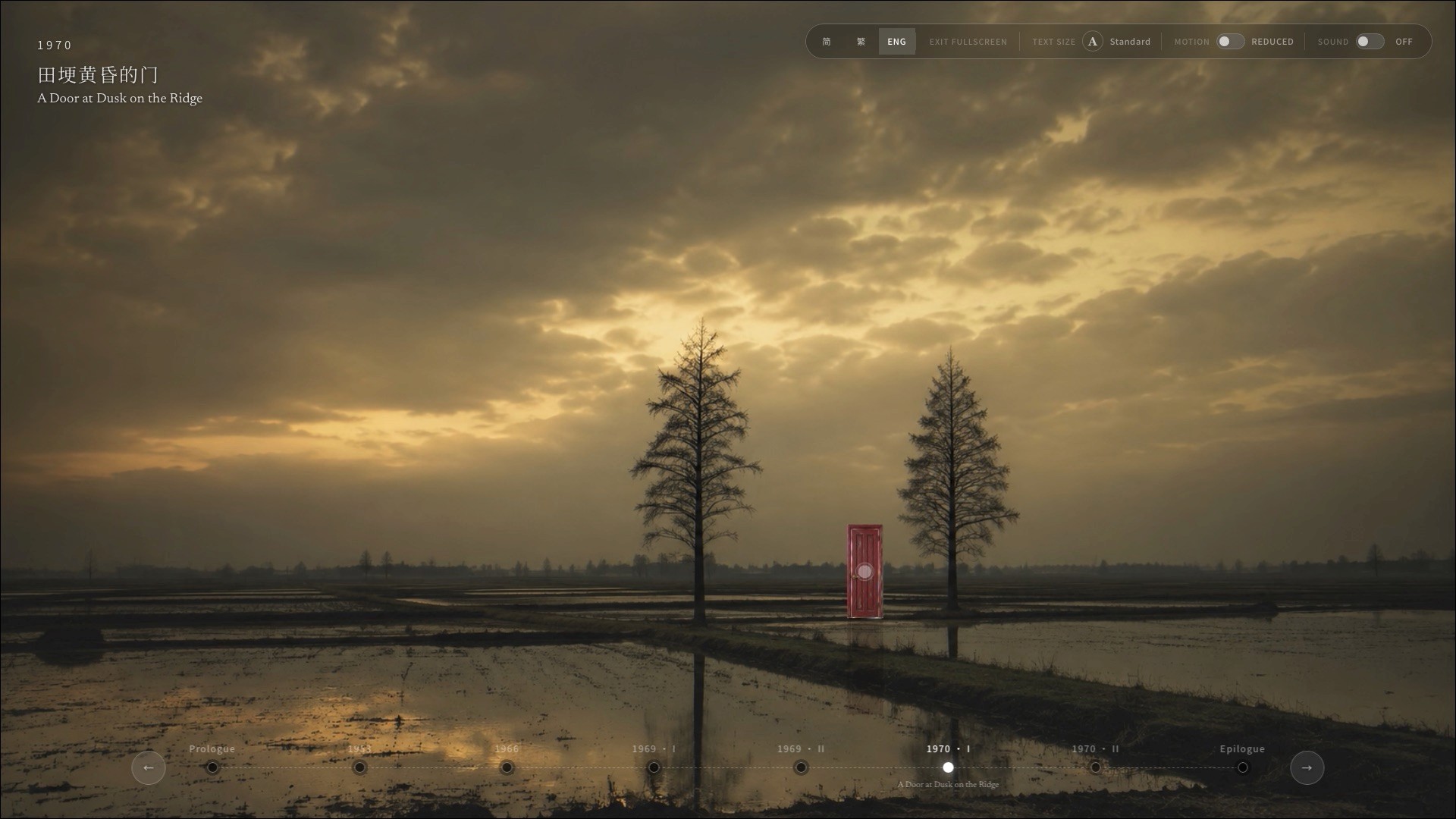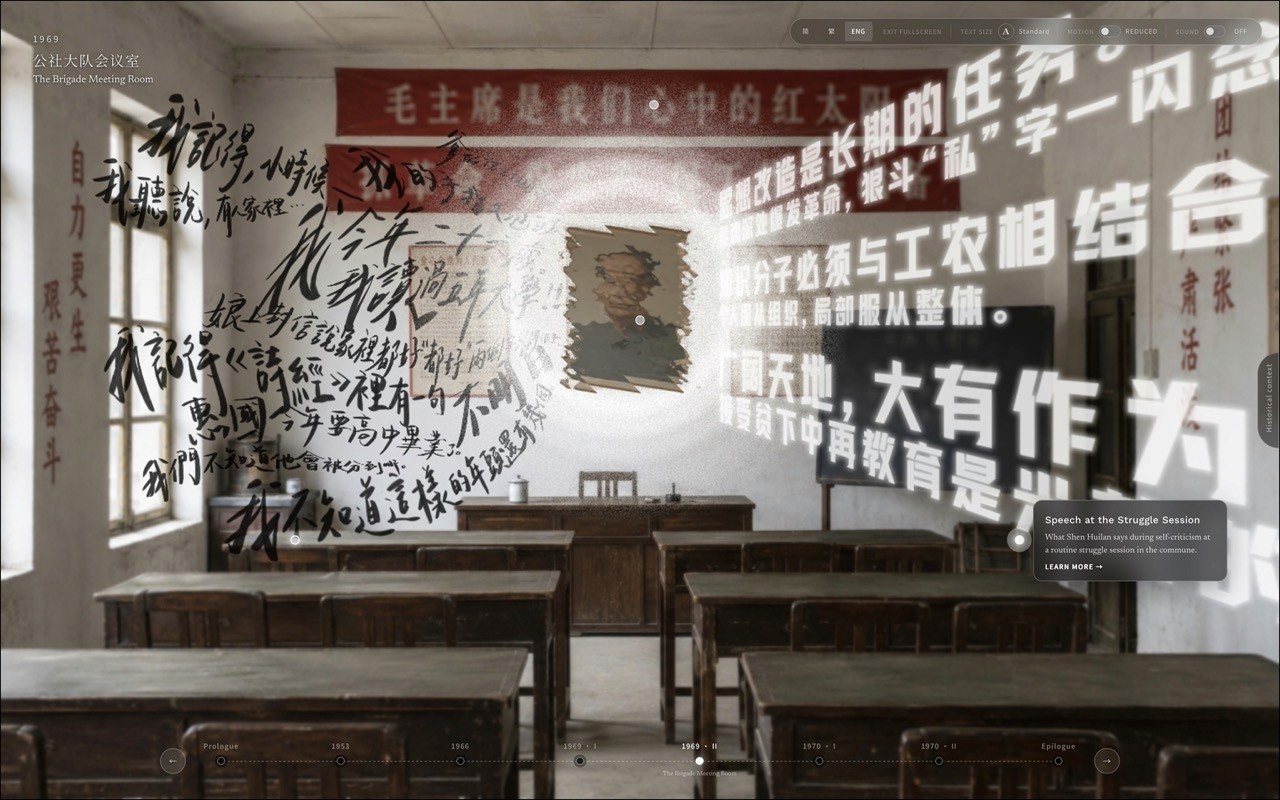
Opening scene of 1970 · The Door, combining a rural classroom with handwritten memories and archival text.

2026

1970 · The Door

An interactive visual narrative across memory and history

{interaction design, narrative design, historical research, visual development, motion design, sound design, creative coding, front-end development}

Photoshop

Photoshop

Illustrator

Illustrator

After Effects

After Effects

Audition

Audition

JavaScript

JavaScript

Claude

Claude

Codex

Codex

Media Encoder

Media Encoder

Overview

A story across two histories

1970 · The Door follows a young Chinese literature teacher from her book-filled childhood to her experience of the Cultural Revolution. After her family is separated, she is sent to rural Anhui as part of the Sent-down Youth Movement. There, an unexpected event confronts her with what that same year looked like elsewhere: Greenwich Village, New York, in 1970.
I researched the historical context and wrote the narrative, then translated both into a six-chapter interactive experience through visual scene-building, motion, sound, and front-end development.

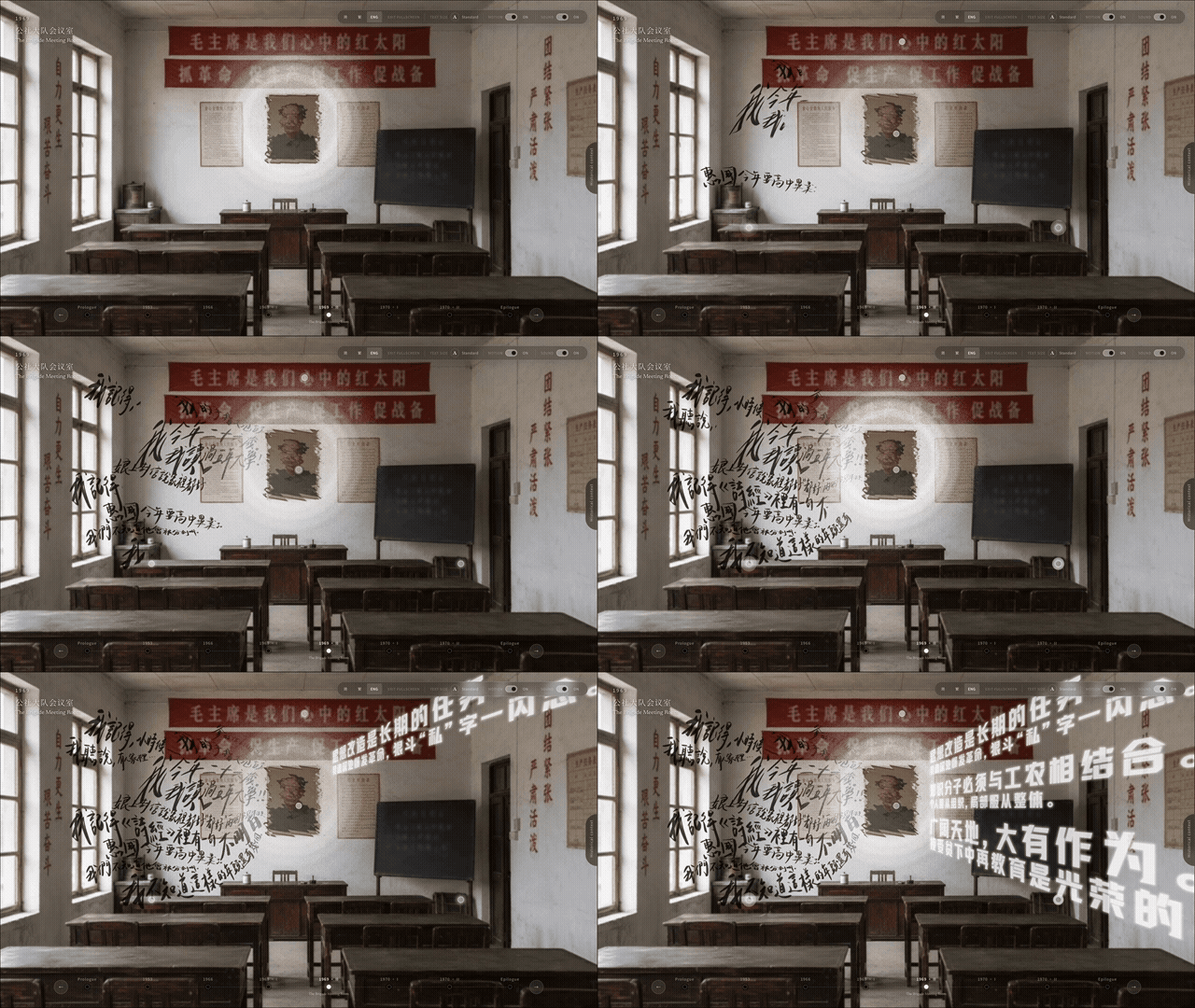
Childhood memory scene combining family photographs, books, household objects, and a map of Anhui.
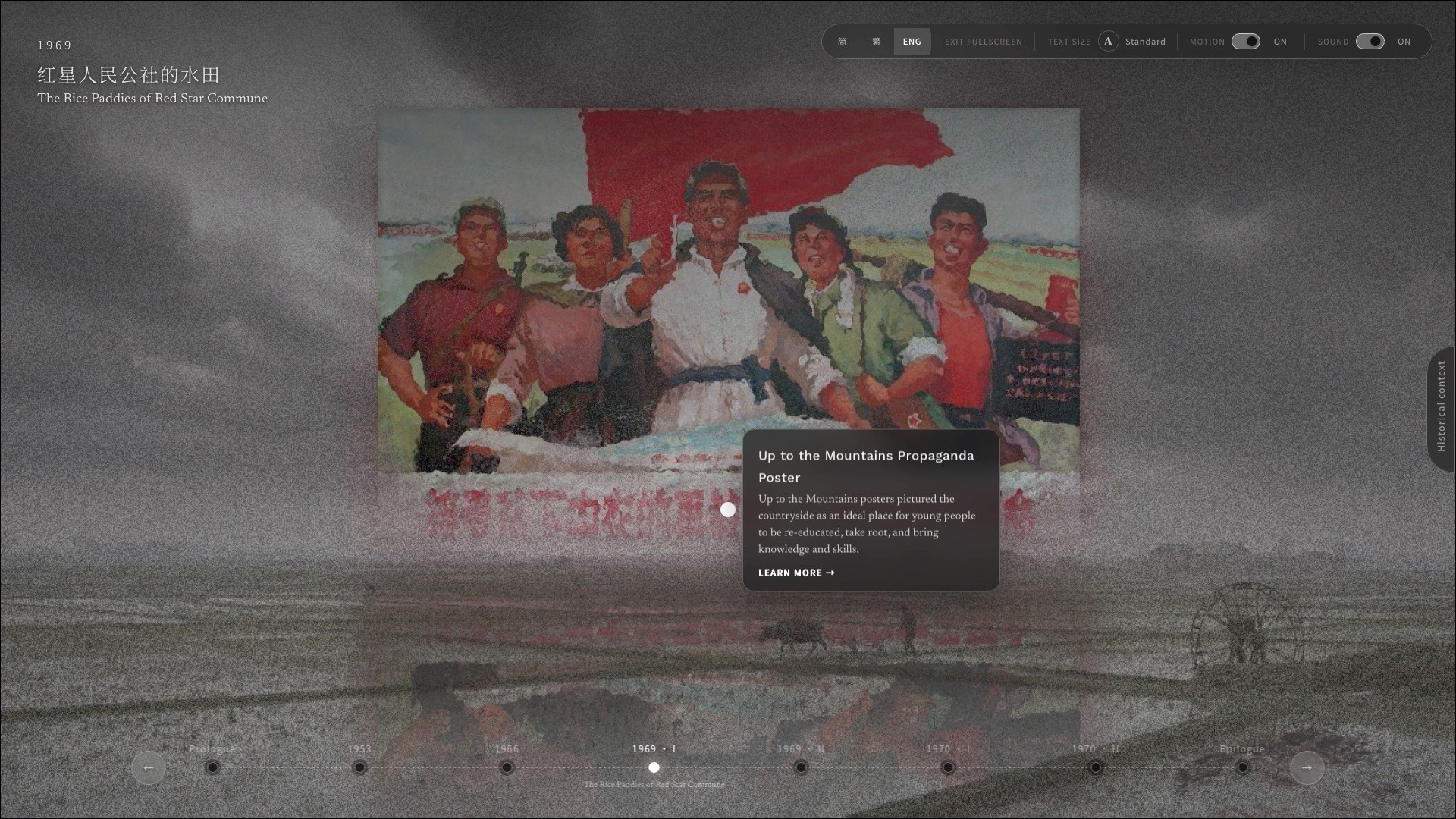
Interactive archival scene presenting a Cultural Revolution propaganda poster with related historical images and context.
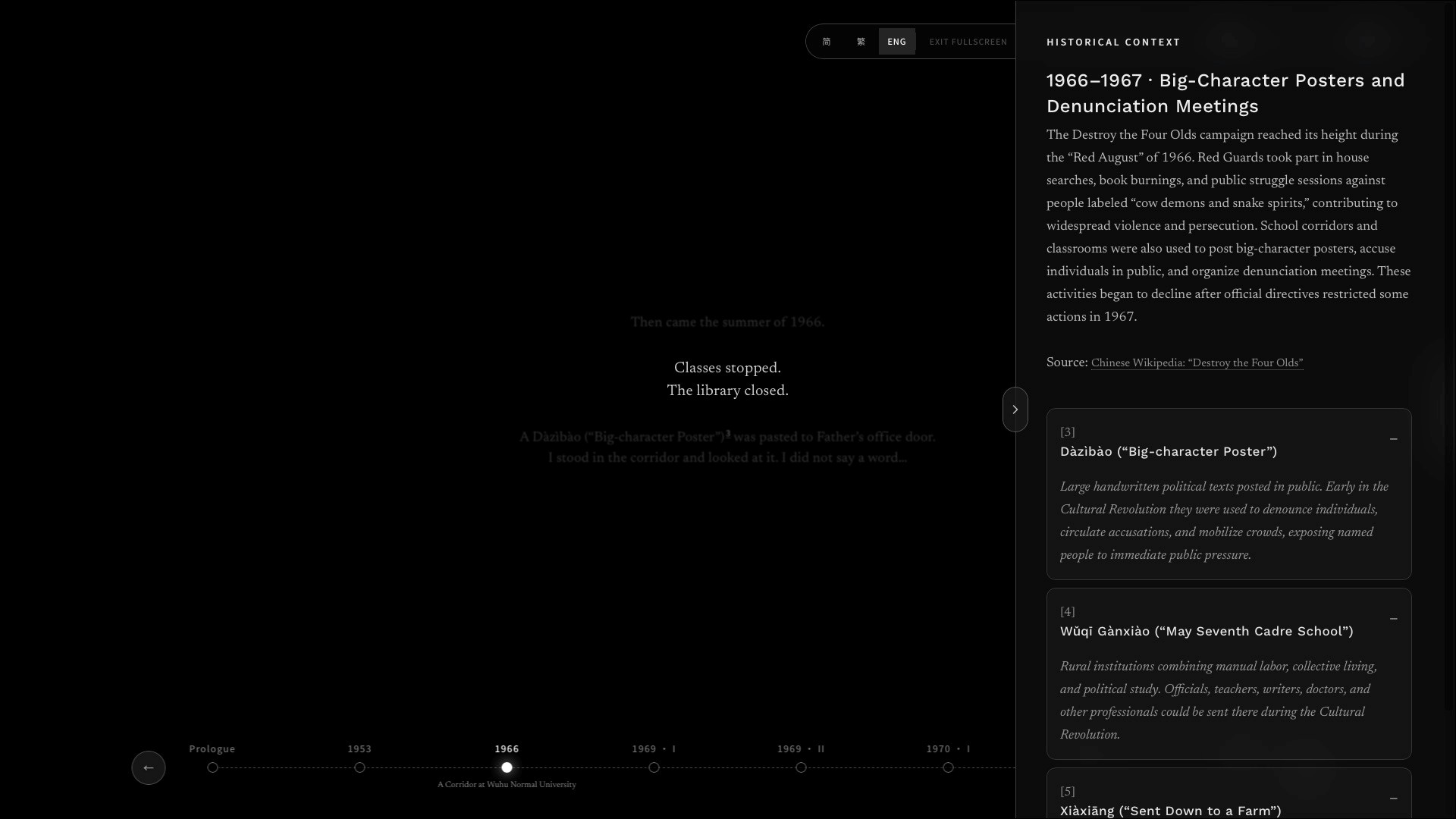
Interactive book scene revealing handwritten records and archival material from the protagonist's education.
Greenwich Village street scene pairing the fictional narrative with photographs of New York in 1970.

Context

Historical research and position

Drawing on first-person accounts, historical archives, photographs, political prints, and other visual and audio records, I developed the historical context surrounding the protagonist’s experience of the Cultural Revolution. Interactive scenes place period-specific environments and objects alongside archival images, cited sources, and contextual information. Rather than using historical material as visual atmosphere, the project keeps the fictional narrative and the historical record distinct but in direct relation to one another.
This structure also reflects the limits of the historical record itself: what is preserved, who was able to document their experience, and what remains absent or contested. The project uses personal narrative alongside archival evidence as two different ways of approaching that history.

Design

Multilingual and cross-device experience

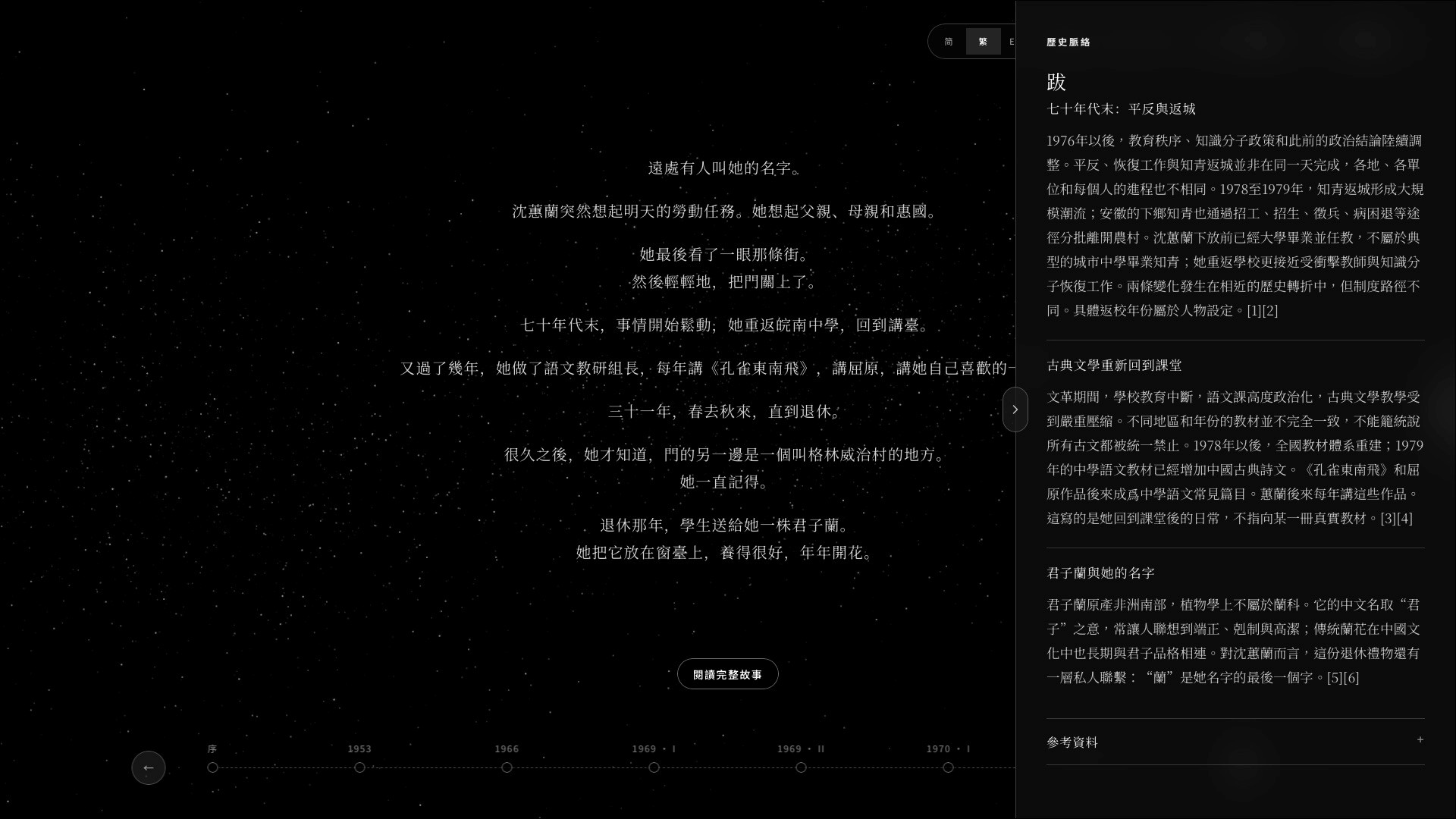
The six-chapter experience combines first-person narration, digital collage, environmental sound, composited motion, archival material, and interactive historical annotations. It is designed for laptops and tablets and is available in Simplified Chinese, Traditional Chinese, and English.
Readers can control sound, motion, text size, fullscreen viewing, and chapter navigation.
The format could also be adapted for museum or archival kiosks and tablets, where the narrative could sit alongside collection objects and primary materials. This would allow visitors to move independently between personal narrative, historical context, and archival evidence.

Mock up of the interactive experience experienced on museum display screen

Process

Translating narrative into interaction

The interactive structure grew out of the original narrative. Each chapter was developed around a specific story moment, its historical context, and the interaction needed to connect the two.

01.

Establish the device

The door creates a point of comparison between the protagonist’s experience in China and the same historical moment elsewhere.

03.

Connect history and narrative

Archival images, documents, objects, and contextual information were selected in relation to specific scenes rather than added as general background.

02.

Map the chapters

The original story was divided into six chapters around key memories, dates, locations, and changes in the protagonist’s experience.

04.

Design interactions

Interaction was designed around the function of each chapter, using scene exploration, archival material, motion, sound, and contextual history reveals where they supported the narrative.

01.

Establish the device

The door creates a point of comparison between the protagonist’s experience in China and the same historical moment elsewhere.

02.

Map the chapters

The original story was divided into six chapters around key memories, dates, locations, and changes in the protagonist’s experience.

03.

Connect history and narrative

Archival images, documents, objects, and contextual information were selected in relation to specific scenes rather than added as general background.

04.

Design interactions

Interaction was designed around the function of each chapter, using scene exploration, archival material, motion, sound, and contextual history reveals where they supported the narrative.

01.

Establish the device

The door creates a point of comparison between the protagonist’s experience in China and the same historical moment elsewhere.

02.

Map the chapters

The original story was divided into six chapters around key memories, dates, locations, and changes in the protagonist’s experience.

03.

Connect history and narrative

Archival images, documents, objects, and contextual information were selected in relation to specific scenes rather than added as general background.

04.

Design interactions

Interaction was designed around the function of each chapter, using scene exploration, archival material, motion, sound, and contextual history reveals where they supported the narrative.

Shuting Zhou

Multidisciplinary designer and researcher based in Toronto.

Contact

shutingzhou.design@gmail.com

Shuting Zhou

Multidisciplinary designer and researcher based in Toronto.

Contact

shutingzhou.design@gmail.com

Shuting Zhou

Multidisciplinary designer and researcher based in Toronto.

Contact

shutingzhou.design@gmail.com